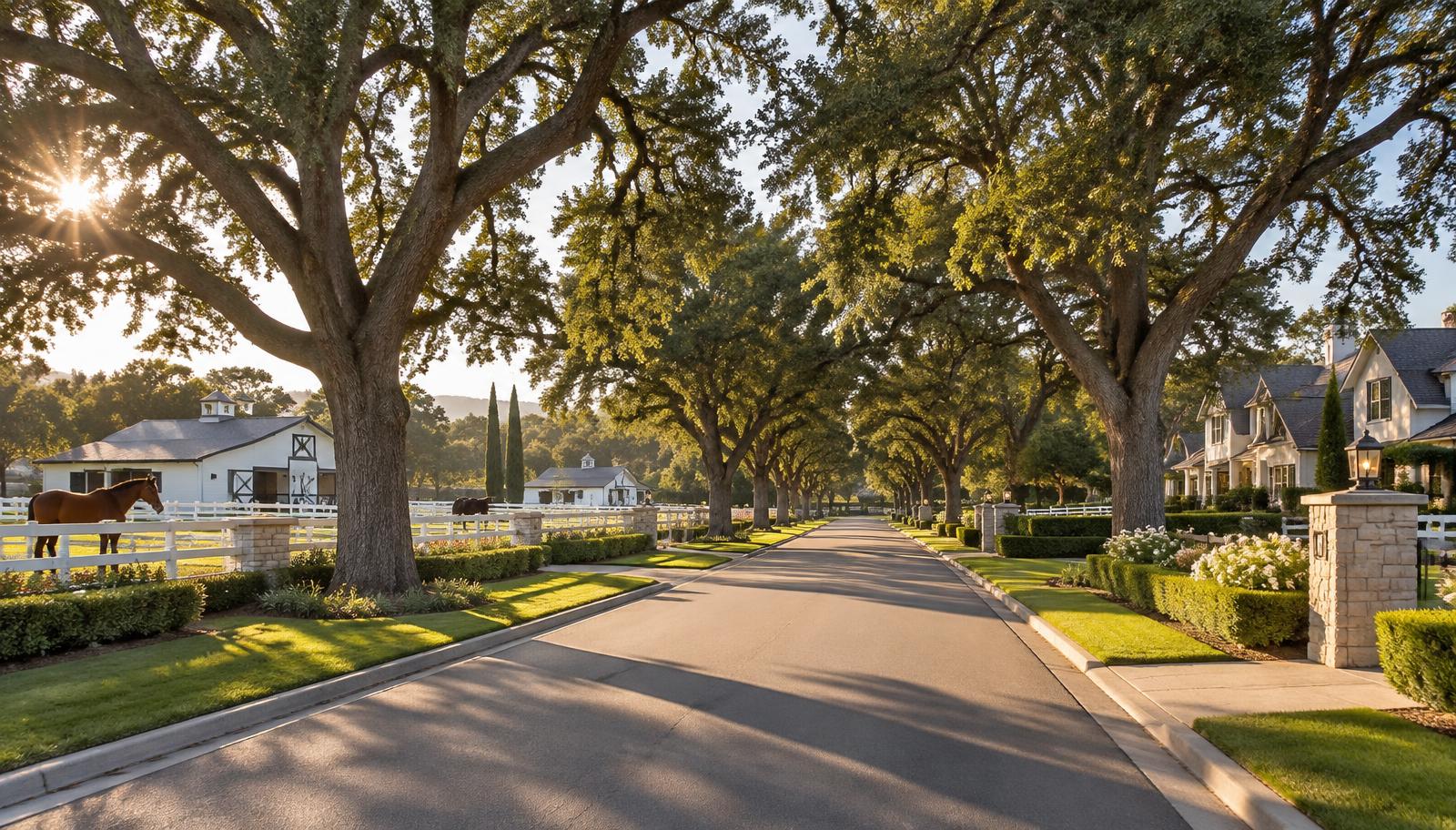
A working horse neighborhood, not a themed one
Plenty of Los Angeles neighborhoods advertise a rural feel. Burbank Rancho earns it. The district occupies the southwest corner of Burbank, bounded loosely by Riverside Drive, Mariposa Street and the edge of Griffith Park, and it was laid out around horses rather than retrofitted for them. Streets carry dedicated bridle paths beside the pavement. Driveways are long enough to swing a two-horse trailer. Fences are white rail rather than block wall, and the tree canopy — mature sycamore, oak and eucalyptus — is dense enough to drop the temperature a few degrees on a summer afternoon.
The anchor is the Los Angeles Equestrian Center on the Burbank side of the river, which brings boarding, lessons, shows and a steady community of riders. From most Rancho addresses you can tack up at home and ride into Griffith Park's trail system without crossing a major road. That single fact — private property with direct trail access inside a major metro — is the reason values here hold up the way they do.
Who lives in the Rancho
The population is more varied than the price points suggest. In rough proportion:
- Entertainment-industry households. Warner Bros., Disney, Universal and Nickelodeon are all within fifteen minutes. Writers, producers, editors, animators and crew make up a large share of buyers who want space without a canyon commute.
- Horse owners. Riders who are tired of paying board and driving to their animals. For them, a property with four usable stalls is not a luxury feature — it is the entire reason they are shopping.
- Multigenerational and legacy families. Households with long ties to the area who value Burbank services, neighborhood relationships, and the Rancho's protected equestrian character.
- Relocating buyers. Families moving in from the Westside, Pasadena or out of state who want Burbank city services, Burbank schools and a yard their kids can actually use.
Housing types and price ranges
There is no single Rancho house. You will find original single-story ranch homes from the mid-century period, later custom two-story builds, and extensively remodeled homes. Lot sizes vary, and the practical usefulness of the rear yard, access, stable placement, and trail connection can matter as much as the recorded square footage.
No single price band describes the Rancho responsibly. Condition, usable land, legal horsekeeping status, outbuildings, access, and the quality of improvements can create large differences even between nearby homes. For current context, see the market trends and home values page.
What actually drives value here
- Usable flat land, measured separately from total lot size
- Legal horsekeeping status and the number of permitted stalls
- Barn, arena, wash rack and tack room quality
- Direct or near-direct bridle path and trail access
- Whether the main house has been systematically updated or only cosmetically touched
Daily life, schools and getting around
Burbank Unified serves the district, and the city's own police, fire and parks departments are a real draw for buyers comparing the Rancho against unincorporated LA County pockets. Magnolia Park's shops and restaurants are a few minutes north, the Burbank Town Center and the Empire Center cover big-box errands, and Bob Hope Airport is close enough for a same-morning flight without a car service. The 134 and the 5 are both easy to reach, which is how residents keep a semi-rural address and still make a 9 a.m. call time on a lot.
What R-1-H zoning means
The Rancho's R-1-H designation is single-family residential zoning with provisions for residents to keep their own horses. Non-commercial stables and corrals may be permitted, with horse capacity tied to lot area and rules governing setbacks, fencing, and separation from living spaces. Buyers should verify the zoning, permit history, and intended horse use for the specific parcel rather than relying on neighborhood assumptions.
Why the Rancho and estate sales overlap so often
Long tenure creates estates. When a family has held a horse property for five decades, the eventual sale usually runs through a living trust or, when no trust exists, through probate. Those sales carry considerations a standard listing does not: trustee authority, beneficiary communication, deferred maintenance across outbuildings, personal property and sometimes livestock that needs a plan of its own. If that describes your situation, the trust and probate sales guide walks through the sequence step by step, and the resources for families page collects the practical checklists.
If you are simply curious what your Rancho home is worth today, or you are shopping the neighborhood for the first time, I am glad to talk it through with no obligation — in English or Mandarin. You can also read about selling a home here or buying in Burbank Rancho.